
In Memoriam: Emma Ileana Greig, 1981–2024
October 1, 2025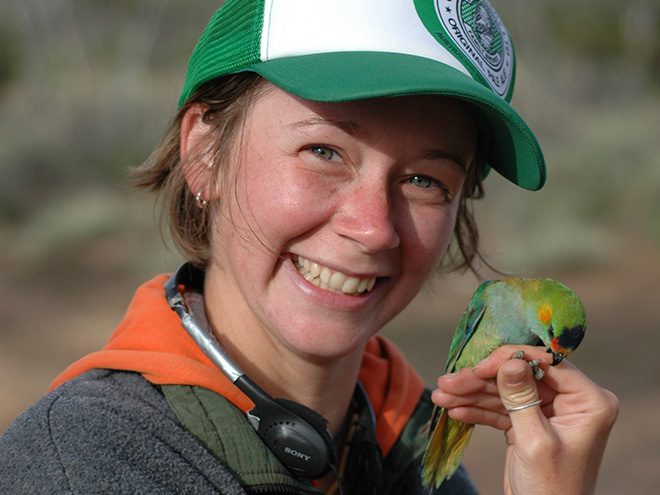
From the Autumn 2025 issue of Living Bird magazine. Subscribe now.


Emma Greig, best known for her role as project leader of the FeederWatch program at the Cornell Lab of Ornithology and her research on the evolution of vocal communication in fairywrens, died on December 24, 2024, after a brief battle with cancer. Emma was just 43 years old when she passed. She is survived by her young daughter, Veda, her partner, Krishna Ramanujan, her sister, and her parents. Emma was a beloved member of the Cornell Lab team, of the broader ornithological community, and of an extensive network of friends and colleagues across the globe.
Emma was born on September 27, 1981, in Rochester, Michigan, where she grew up before attending college. She showed a precocious interest in birds and began breeding and raising Australian finches at an early age, keeping detailed records of their behavior. As a teenager, she was a frequent author of papers in aviculture magazines, publishing her first paper when she was just 14 years old. At age 15, she published a paper in Bird Talk magazine entitled “Can Pet Birds Express Emotion,” a sign of her sensitivity to and proclivity for research in bird behavior.
Emma completed her undergraduate work in biology, with a minor in chemistry, at Oakland University in Rochester, Michigan, graduating Summa Cum Laude in 2003. She was awarded nine scholarships, fellowships, or awards, and published two research papers (one on moths, and another on wasps) during her undergraduate work.
Emma entered the PhD program at the University of Chicago in 2004 and graduated in 2010. She joined Steve Pruett-Jones’ long-term research program on Splendid Fairywrens in South Australia, focusing on vocal communication and signal evolution. This was perfectly timed because it provided an opportunity for Emma to combine her skills in naturalistic observations, love of fieldwork, and ability to design field experiments. Emma was a truly gifted field biologist. During work on the study site, she became so good at finding nests by hearing the calls that females give to their chicks (while still in the egg) that other members of the field team simply followed Emma around while she found most of the nests in the population.
Through an extensive and difficult set of field experiments, Emma showed that a type of vocalization among fairywrens, long thought to be an alarm call, is in fact a sexual display: Males use the predator call as an alerting signal onto which they piggyback their display call. When Emma first realized this, she declared “This is just like the scary movie effect in humans”—as in using a horror film as an excuse for teenagers to bring their dates closer, a metaphor that received a lot of attention in the public science media.
At the end of Emma’s PhD, she attended a scientific conference where she had a conversation with Mike Webster, who was just starting a position as a professor in the Department of Neurobiology and Behavior at Cornell University. That conversation led to a postdoctoral position at the Cornell Lab and an opportunity to continue working on signal evolution in fairywrens. Through nearly a year of fieldwork, Emma showed that the predator-elicited displays she had documented in male Splendid Fairywrens are a general pattern of behavior in fairywrens, and in many species have been elaborated into more complex displays. In collaboration with PhD student Daniel Baldassarre, she conducted a massive field playback experiment (541 separate trials) in Red-backed Fairywrens. By cleverly combining experimental playback data with genetic parentage analyses, Emma and Dan demonstrated that males use duetting as a form of acoustic mate guarding. During her postdoctoral days, Emma also continued working on field courses and participating in field expeditions, leading to a rich scientific legacy beyond her publications, including nearly 1,000 excellent audio recordings archived in the Cornell Lab’s Macaulay Library of natural history media.
At the end of her postdoctoral appointment at the Cornell Lab, Emma leaped at the opportunity to become the project leader for Project FeederWatch, one of the world’s largest and most successful participatory science programs. While many of her new duties were outside of Emma’s formal training, she thrived on her interactions with the public and led the team with her positive, ‘How can we solve this puzzle?’–style. Despite the demands of her administrative responsibilities, Emma also kept up original research and published more than 20 papers. Many of these papers used FeederWatch data, further solidifying the importance of participatory science data in asking novel questions.
Notably, Emma brought her passion for animal behavior to FeederWatch. One of her most productive and impactful collaborations was with Eliot Miller, then a postdoctoral research associate at the Cornell Lab, in engaging the FeederWatch audience to record tens of thousands of data points on dominance behavior at feeders. This initiative proved very popular with the FeederWatch audience and the media and continues to be fertile ground for scientific publications [see When 136 Species Show Up at a Feeder, Which One Wins? Winter 2018]. Emma was also dedicated to increasing the use and accessibility of the open-access FeederWatch dataset, publishing a data paper and regularly assisting the research community in using the data stream in creative ways.
More recently, Emma was a key part of a multi-institutional project, funded by the National Science Foundation, focused on FeederWatch, expanding the program into a socio-environmental research program. Through this project, Emma engaged the public in novel scientific research right up to her untimely death, presenting research from the project at the American Ornithological Society conference in Estes Park, Colorado, less than three months before her passing. Months before Emma received her diagnosis, she told colleagues at the Cornell Lab that she wanted to be the leader of FeederWatch for life. This made perfect sense because the job allowed Emma to engage in everything that she was great at: engage with people about her love of birds and excitement about science, teach field courses, conduct fieldwork on her own research, and collaborate with other biologists.
Although Emma’s job with FeederWatch did not explicitly involve teaching and mentoring students, she embraced teaching and created countless opportunities for the next generation, including several of the bright young minds in ornithology today. Emma’s teaching and mentoring focused on creating impactful field experiences for students, where she intuitively helped students gain life skills as well as ornithological research skills. She was masterful at dealing with adversity and helping students adjust to challenging circumstances, whether in the deserts of the American Southwest, the jungles of Borneo, or the savannas of East Africa.
After Gouldian Finches and fairywrens, Emma’s other ornithological passion was the Verdin, which she studied for over a decade at Organ Pipe Cactus National Monument in Arizona. This work had its origins when she was a teaching assistant for Professor Eric Larsen’s Desert Ecology course at the University of Chicago. She participated in that course for many years, and once she was at the Cornell Lab, this participation morphed into her own independent research and teaching program. She led annual training expeditions with Cornell undergraduate students to Organ Pipe during spring break, camping with the students while continuing her long-term population studies. In all, Emma published research with a dozen different Cornell undergraduate students.
More About Emma

Despite her career only really getting started, Emma received numerous awards including being made an Elective Member of the American Ornithological Society in 2017 and a Fellow in 2020. She received numerous research grants, including funding from the National Science Foundation and the American Ornithologists’ Union. In addition, her work with private donors and the public secured millions of dollars, making Project FeederWatch possible.
Emma was a creative and accomplished biologist, but it was her personality that most people will remember. She had a delightful, inviting, and often goofy personality that immediately put people at ease. She loved people and was happiest when sharing her fascination with the natural world and birds with anyone who would listen. Selfless, kind, considerate, and generous are all terms that people have used in social media posts to describe Emma’s character and personality. These traits made Emma a great collaborator, an effective mentor, a gifted leader, and a wonderful field camp companion.
Emma’s publications will stand the test of time given their creativity, as well as the amount of extensive fieldwork needed to gather the data presented. Nevertheless, citations or not, Emma touched so many lives with her humor and grace that her legacy will ultimately be in the lives of the people who knew her. Being remembered as much for the warm memories of other people as for one’s professional accomplishments is an indication of a life well lived. That was Emma Greig. She enriched the lives of everyone who met her, and we miss her every day.
This obituary first appeared in the October 2025 issue of the journal Ornithology, published by the American Ornithological Society. It has been slightly condensed and is reprinted here with permission. Read the full version.
About the Authors
Stephen Pruett-Jones is an associate professor in the Department of Ecology and Evolution at the University of Chicago. Michael Webster and David Bonter are director of the Macaulay Library and co-director of the Center for Engagement in Science and Nature, respectively, at the Cornell Lab of Ornithology.

All About Birds
is a free resource
Available for everyone,
funded by donors like you
American Kestrel by Blair Dudeck / Macaulay Library